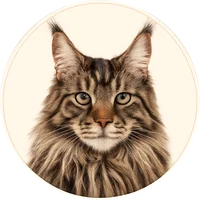
Maine Coon at a glance
- Origin
- United States (Maine)
- Size
- Large: roughly 10–20 lb (4.5–9 kg), males larger
- Coat
- Semi-long, shaggy, brush weekly
- Temperament
- Gentle, sociable, playful
- Energy
- Moderate
- Grooming
- Moderate to high
- Known for
- Size, tufted ears, chirps and trills
How big do Maine Coons get?
Maine Coons are among the largest pedigreed cats. The Cat Fanciers' Association describes them as weighing roughly 10 to 20 pounds (4.5 to 9 kg), with males at the heavier end. They also mature slowly, and many keep filling out until they are three to five years old, so a young Maine Coon can still look "in between" sizes for a long time.
What is a Maine Coon's personality like?
Maine Coons are usually described as friendly, gentle and people-oriented rather than clingy. Many follow their owners from room to room, greet people at the door, and communicate with soft chirps and trills instead of loud meows. They tend to enjoy interactive play and puzzle feeders, and many are comfortable around calm children and cat-friendly dogs. Individual temperament varies, so meet the particular cat or kitten before you decide.
How much grooming does a Maine Coon need?
The long, uneven coat is easier to care for than it looks, because it is less silky and prone to matting than some long-haired breeds. Plan on a thorough comb-through about once or twice a week, paying attention to the belly, behind the ears and the "britches" on the back legs. Expect heavier shedding during seasonal coat changes. Our grooming tips cover tools and technique.
What health problems affect Maine Coons?
The most important is hypertrophic cardiomyopathy (HCM), a thickening of the heart muscle that is the most common heart disease in cats overall. In Maine Coons, one variant of the MYBPC3 gene (called A31P) is linked to HCM, and a DNA test for it exists. A normal test result does not rule out HCM, because other causes are possible, so responsible breeders combine genetic testing with heart ultrasound by a veterinary cardiologist. Hip problems and spinal muscular atrophy (SMA) have also been reported in the breed, and a gene test exists for SMA.
If you buy from a breeder, ask for the parents' heart-screening and genetic-test results in writing. A vet can listen for heart murmurs, but a normal exam does not exclude HCM.
Is a Maine Coon right for you?
A Maine Coon suits a household that wants a big, affectionate companion and can commit to regular brushing, sturdy furniture such as a large cat tree, and vet costs that may be higher than average for a large breed. If you would rather skip long-coat grooming, a shorter-haired breed such as the British Shorthair may be an easier fit. Not sure? Try our breed finder quiz.
Sources and further reading
- Cat Fanciers' Association (CFA): breed information and registration standards
- CFA: Most Popular Breeds for 2023
- OMIA: Feline familial hypertrophic cardiomyopathy (MYBPC3 tests for Maine Coon and Ragdoll)
- Frontiers in Veterinary Science (2024): Classification of feline HCM-associated gene variants
- Cornell Feline Health Center: veterinary health information for cats