Ragdoll at a glance
- Origin
- United States (California, 1960s)
- Size
- Large: roughly 10–20 lb (4.5–9 kg), males larger
- Coat
- Semi-long, silky, brush 2–3×/week
- Temperament
- Docile, affectionate, relaxed
- Energy
- Low to moderate
- Grooming
- Moderate
- Known for
- Blue eyes and a relaxed, cuddly nature
Where does the Ragdoll come from?
The Ragdoll was developed in California in the 1960s. The Cat Fanciers' Association first recognized it as an official breed in 1998, and it has been one of the most-registered breeds in CFA's popularity rankings in recent years.
What is a Ragdoll's personality like?
Ragdolls are known for a laid-back, gentle temperament. Many enjoy being held, follow their people around and tolerate handling well. The name comes from the tendency of some cats to relax when picked up, though this varies a lot from cat to cat, and every Ragdoll still needs to be lifted with its hindquarters supported. They are usually quiet and moderately playful, which suits calm homes and families.
How big do Ragdolls get, and what do they look like?
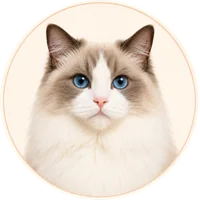
They are large, with males typically heavier than females, and often take a few years to reach full size. The coat comes in three patterns (colorpoint, mitted and bicolor) and all Ragdolls have blue eyes.
How much grooming does a Ragdoll need?
The semi-long coat is silky and has little undercoat, so it mats less than many long-haired coats, but it still needs combing two or three times a week, more during shedding. Check behind the ears, under the legs and around the "pants". See our grooming tips.
What health problems affect Ragdolls?
Hypertrophic cardiomyopathy (HCM) is the key concern. A variant in the MYBPC3 gene is associated with HCM in Ragdolls, and a DNA test is available, as it is for Maine Coons. Researchers advise that a negative test does not guarantee a cat will never develop HCM, so ask breeders about heart-ultrasound screening as well. Weight management also matters, because a calm cat that plays less can gain weight easily.
Is a Ragdoll right for you?
Ragdolls are a good match if you want a gentle lap cat and can keep it safely indoors. Their trusting nature is a reason to avoid unsupervised outdoor access. Compare with the sturdier, less cuddly British Shorthair or the more active Bengal.
Sources and further reading
- Cat Fanciers' Association (CFA): breed information and registration standards
- CFA: Most Popular Breeds for 2023
- OMIA: Feline familial hypertrophic cardiomyopathy (MYBPC3 tests for Maine Coon and Ragdoll)
- Frontiers in Veterinary Science (2024): Classification of feline HCM-associated gene variants
- Cornell Feline Health Center: veterinary health information for cats